- Authors
- Name
- Listen via Podcast
- 1. Introduction
- 2. 5 Key Expressions
- 3. Practical Conversation: Hospital Visit
- 4. Fill in the Blanks
- 5. Speaking Practice
- 6. Translation Quiz (Korean to Japanese)
- 7. Grammar Points
- 8. Essential Hospital Vocabulary
- References
Listen via Podcast
1. Introduction
Today, let's study conversations at the hospital. When you are not feeling well, it is important to accurately describe your symptoms to the doctor. Let's learn commonly used expressions following the flow of a medical examination.
2. 5 Key Expressions
| # | Japanese | Reading | English |
|---|---|---|---|
| 1 | 具合が悪いんです | ぐあいが わるいんです | I'm not feeling well |
| 2 | 熱があります | ねつが あります | I have a fever |
| 3 | 頭が痛いです | あたまが いたいです | I have a headache |
| 4 | 処方箋を出しますね | しょほうせんを だしますね | I'll give you a prescription |
| 5 | お大事に | おだいじに | Take care of yourself |
Usage Patterns
The pattern "~が痛(いた)いです" can be used to describe different body parts that hurt:
| Japanese | Reading | Meaning |
|---|---|---|
| 頭が痛いです | あたまが いたいです | I have a headache |
| お腹が痛いです | おなかが いたいです | I have a stomachache |
| 喉が痛いです | のどが いたいです | I have a sore throat |
| 歯が痛いです | はが いたいです | I have a toothache |
| 腰が痛いです | こしが いたいです | My lower back hurts |
3. Practical Conversation: Hospital Visit
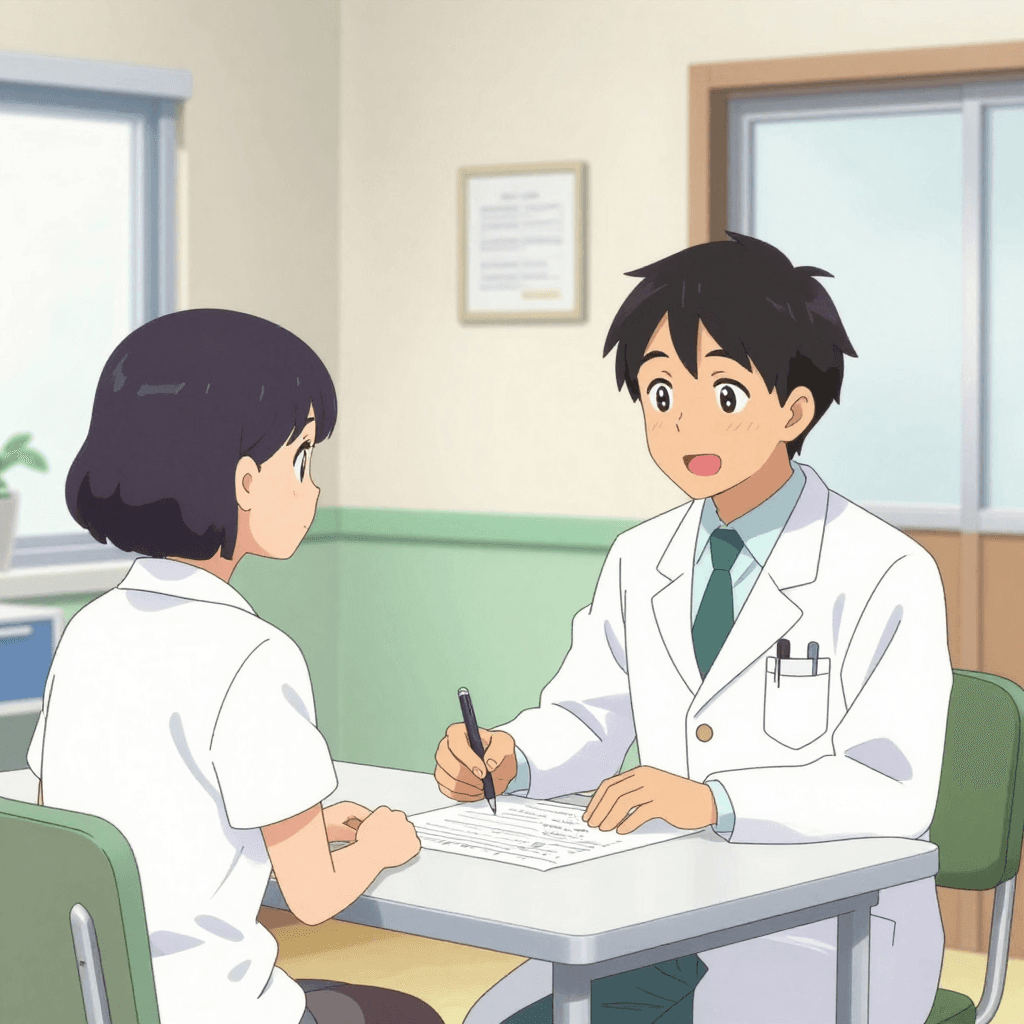
Scene: Examination room at internal medicine (内科, ないか) after check-in
Doctor (医者, いしゃ): 今日(きょう)はどうされましたか? (What brings you here today?)
Patient (患者, かんじゃ): 三日前(みっかまえ)から具合(ぐあい)が悪(わる)くて、熱(ねつ)もあります。 (I've been feeling unwell since 3 days ago and I have a fever too.)
Doctor: 熱(ねつ)は何度(なんど)くらいですか? (How high is your temperature?)
Patient: 昨日(きのう)の夜(よる)は38度(さんじゅうはちど)ありました。 (It was 38 degrees last night.)
Doctor: 他(ほか)に症状(しょうじょう)はありますか?咳(せき)とか、喉(のど)の痛(いた)みとか。 (Do you have any other symptoms? Such as a cough or sore throat.)
Patient: はい、咳(せき)が出(で)て、喉(のど)も少(すこ)し痛(いた)いです。 (Yes, I have a cough and my throat is a bit sore.)
Doctor: 分(わ)かりました。薬(くすり)のアレルギーはありますか? (I see. Do you have any drug allergies?)
Patient: いいえ、特(とく)にないです。 (No, not in particular.)
Doctor: では、お薬(くすり)を出(だ)しますね。処方箋(しょほうせん)を受付(うけつけ)で受(う)け取(と)ってください。 (Then I'll prescribe some medicine. Please pick up the prescription at the reception desk.)
Patient: ありがとうございます。いつ頃(ごろ)治(なお)りますか? (Thank you. When will I get better?)
Doctor: 3日(みっか)ほどで良(よ)くなると思(おも)います。お大事(だいじ)に。 (You should feel better in about 3 days. Take care.)
4. Fill in the Blanks
__が悪(わる)いんです。(physical condition) answer: 具合(ぐあい)
昨日(きのう)から__があります。(fever) answer: 熱(ねつ)
お腹(なか)が__です。(hurts) answer: 痛(いた)い
__を出(だ)しますね。(prescription) answer: 処方箋(しょほうせん)
薬(くすり)は食後(しょくご)に__ください。(please take) answer: 飲(の)んで
5. Speaking Practice
Try saying these naturally in Japanese:
1. "I've had a cough since 3 days ago" answer: 三日前(みっかまえ)から咳(せき)が出(で)ます
2. "I have a drug allergy" answer: 薬(くすり)のアレルギーがあります
3. "When will I get better?" answer: いつ頃(ごろ)治(なお)りますか
6. Translation Quiz (Korean to Japanese)
1. Where does it hurt? answer: どこが痛(いた)いですか
2. Please show me your insurance card. answer: 保険証(ほけんしょう)を見(み)せてください
3. You need to get an injection. answer: 注射(ちゅうしゃ)を打(う)たなければなりません
7. Grammar Points
"~んです" -- Expression for explaining or giving a reason
Rather than simply saying "具合(ぐあい)が悪(わる)いです," using "具合が悪いんです" sounds more natural. "~んです" is used when explaining a situation or conveying a reason.
Plain form + んです
i-adjective: 痛い → 痛いんです
na-adjective: 元気だ → 元気なんです
Noun: 風邪だ → 風邪なんです
Verb: 出る → 出るんです
"~てください" -- Polite request
保険証を見せてください (Please show me your insurance card)
ここに座ってください (Please sit here)
口を開けてください (Please open your mouth)
8. Essential Hospital Vocabulary
| Japanese | Reading | English |
|---|---|---|
| 病院 | びょういん | Hospital |
| 内科 | ないか | Internal Medicine |
| 外科 | げか | Surgery |
| 歯科 | しか | Dentistry |
| 眼科 | がんか | Ophthalmology |
| 受付 | うけつけ | Reception |
| 診察 | しんさつ | Examination |
| 注射 | ちゅうしゃ | Injection |
| 薬局 | やっきょく | Pharmacy |
| 保険証 | ほけんしょう | Insurance Card |
| 風邪 | かぜ | Cold |
| 花粉症 | かふんしょう | Hay Fever |
References
- JLPT N5-N4 Essential Medical Vocabulary
- Practical Japanese Conversation -- Hospital/Medical Examination Edition