Split View: Redis Cluster 구축과 운영 실전 가이드 — 샤딩, 레플리케이션, 페일오버
Redis Cluster 구축과 운영 실전 가이드 — 샤딩, 레플리케이션, 페일오버
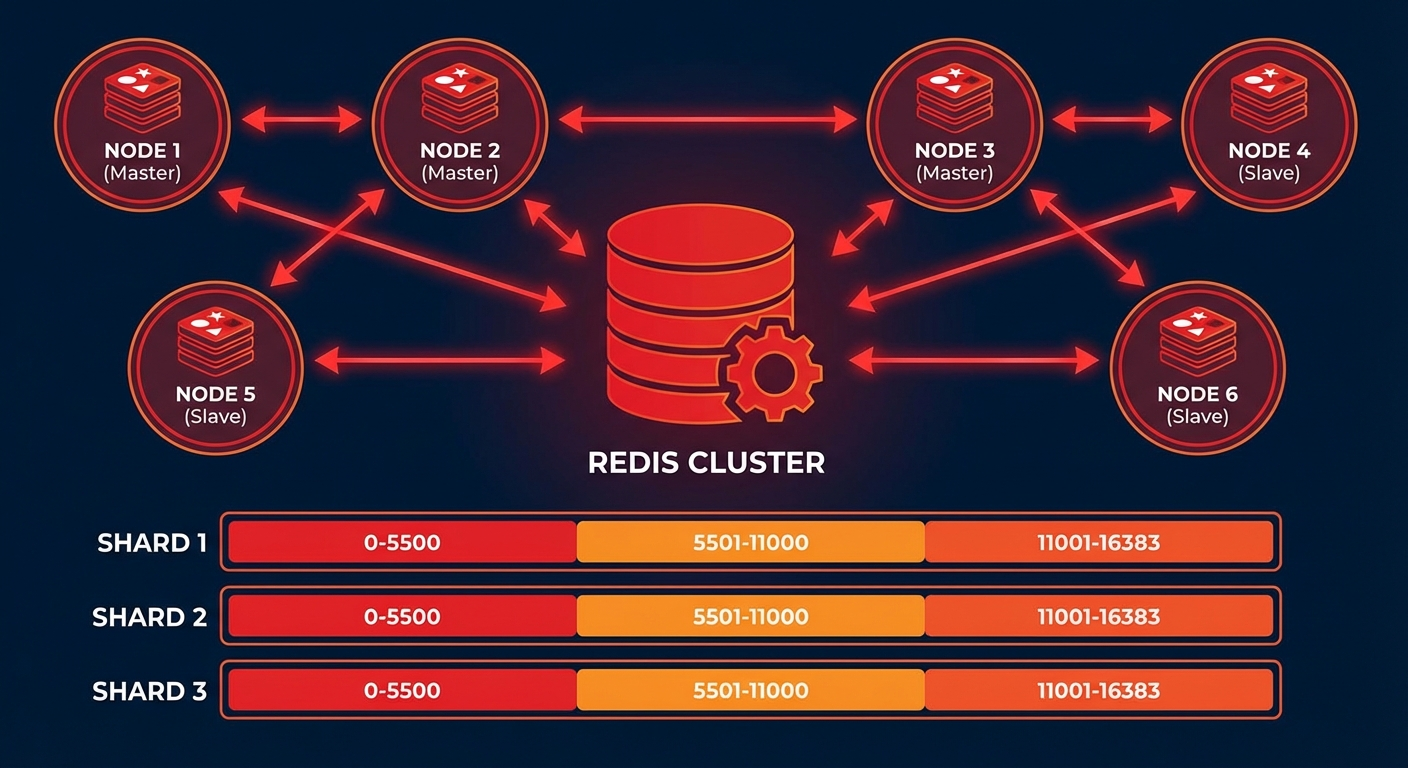
들어가며
단일 Redis 인스턴스는 메모리와 처리량에 한계가 있습니다. Redis Cluster는 데이터를 여러 노드에 자동으로 분산(샤딩)하고, 노드 장애 시 자동 페일오버를 제공하는 네이티브 클러스터링 솔루션입니다.
이 글에서는 Redis Cluster의 아키텍처를 이해하고, 실제 구축부터 운영까지 단계별로 살펴봅니다.
Redis Cluster 아키텍처
해시 슬롯 (Hash Slots)
Redis Cluster는 16,384개의 해시 슬롯을 사용하여 데이터를 분산합니다:
# 키의 해시 슬롯 계산
# HASH_SLOT = CRC16(key) % 16384

# 예시: 3개 마스터 노드
# Node A: 슬롯 0 ~ 5460
# Node B: 슬롯 5461 ~ 10922
# Node C: 슬롯 10923 ~ 16383
클러스터 토폴로지
# 최소 권장 구성: 3 Master + 3 Replica = 6 노드
#
# Master A (슬롯 0-5460)    ←→  Replica A'
# Master B (슬롯 5461-10922) ←→  Replica B'
# Master C (슬롯 10923-16383) ←→  Replica C'
#
# 각 Master가 다운되면 해당 Replica가 자동 승격
6노드 Redis Cluster 구축
Docker Compose로 구축
# docker-compose.yml
version: '3.8'

services:
  redis-node-1:
    image: redis:7.4
    container_name: redis-node-1
    ports:
      - '7001:7001'
      - '17001:17001'
    volumes:
      - ./redis-node-1:/data
    command: >
      redis-server
      --port 7001
      --cluster-enabled yes
      --cluster-config-file nodes.conf
      --cluster-node-timeout 5000
      --appendonly yes
      --protected-mode no
      --bind 0.0.0.0
    networks:
      redis-cluster:
        ipv4_address: 172.20.0.11

  redis-node-2:
    image: redis:7.4
    container_name: redis-node-2
    ports:
      - '7002:7002'
      - '17002:17002'
    volumes:
      - ./redis-node-2:/data
    command: >
      redis-server
      --port 7002
      --cluster-enabled yes
      --cluster-config-file nodes.conf
      --cluster-node-timeout 5000
      --appendonly yes
      --protected-mode no
      --bind 0.0.0.0
    networks:
      redis-cluster:
        ipv4_address: 172.20.0.12

  redis-node-3:
    image: redis:7.4
    container_name: redis-node-3
    ports:
      - '7003:7003'
      - '17003:17003'
    volumes:
      - ./redis-node-3:/data
    command: >
      redis-server
      --port 7003
      --cluster-enabled yes
      --cluster-config-file nodes.conf
      --cluster-node-timeout 5000
      --appendonly yes
      --protected-mode no
      --bind 0.0.0.0
    networks:
      redis-cluster:
        ipv4_address: 172.20.0.13

  redis-node-4:
    image: redis:7.4
    container_name: redis-node-4
    ports:
      - '7004:7004'
      - '17004:17004'
    volumes:
      - ./redis-node-4:/data
    command: >
      redis-server
      --port 7004
      --cluster-enabled yes
      --cluster-config-file nodes.conf
      --cluster-node-timeout 5000
      --appendonly yes
      --protected-mode no
      --bind 0.0.0.0
    networks:
      redis-cluster:
        ipv4_address: 172.20.0.14

  redis-node-5:
    image: redis:7.4
    container_name: redis-node-5
    ports:
      - '7005:7005'
      - '17005:17005'
    volumes:
      - ./redis-node-5:/data
    command: >
      redis-server
      --port 7005
      --cluster-enabled yes
      --cluster-config-file nodes.conf
      --cluster-node-timeout 5000
      --appendonly yes
      --protected-mode no
      --bind 0.0.0.0
    networks:
      redis-cluster:
        ipv4_address: 172.20.0.15

  redis-node-6:
    image: redis:7.4
    container_name: redis-node-6
    ports:
      - '7006:7006'
      - '17006:17006'
    volumes:
      - ./redis-node-6:/data
    command: >
      redis-server
      --port 7006
      --cluster-enabled yes
      --cluster-config-file nodes.conf
      --cluster-node-timeout 5000
      --appendonly yes
      --protected-mode no
      --bind 0.0.0.0
    networks:
      redis-cluster:
        ipv4_address: 172.20.0.16

networks:
  redis-cluster:
    driver: bridge
    ipam:
      config:
        - subnet: 172.20.0.0/24
# 컨테이너 시작
docker compose up -d

# 클러스터 생성 (3 master + 3 replica)
docker exec -it redis-node-1 redis-cli --cluster create \
  172.20.0.11:7001 172.20.0.12:7002 172.20.0.13:7003 \
  172.20.0.14:7004 172.20.0.15:7005 172.20.0.16:7006 \
  --cluster-replicas 1 --cluster-yes

# 클러스터 상태 확인
docker exec -it redis-node-1 redis-cli -p 7001 cluster info
docker exec -it redis-node-1 redis-cli -p 7001 cluster nodes
베어메탈/VM에서 구축
# Redis 설치 (Ubuntu)
sudo apt update && sudo apt install -y redis-server

# 노드별 설정 파일 생성
cat > /etc/redis/redis-7001.conf << 'EOF'
port 7001
cluster-enabled yes
cluster-config-file nodes-7001.conf
cluster-node-timeout 5000
appendonly yes
appendfilename "appendonly-7001.aof"
dbfilename dump-7001.rdb
dir /var/lib/redis/7001
logfile /var/log/redis/redis-7001.log
pidfile /var/run/redis/redis-7001.pid
protected-mode no
bind 0.0.0.0

# 메모리 설정
maxmemory 4gb
maxmemory-policy allkeys-lru

# 성능 튜닝
tcp-backlog 511
timeout 0
tcp-keepalive 300
EOF

# 디렉토리 생성
sudo mkdir -p /var/lib/redis/7001
sudo chown redis:redis /var/lib/redis/7001

# 서비스 시작
sudo redis-server /etc/redis/redis-7001.conf --daemonize yes

# 6개 노드 모두 시작 후 클러스터 생성
redis-cli --cluster create \
  192.168.1.1:7001 192.168.1.2:7002 192.168.1.3:7003 \
  192.168.1.4:7004 192.168.1.5:7005 192.168.1.6:7006 \
  --cluster-replicas 1
클러스터 운영
데이터 읽기/쓰기
# 클러스터 모드로 접속 (-c 플래그)
redis-cli -c -h 172.20.0.11 -p 7001

# MOVED 리다이렉션 자동 처리
172.20.0.11:7001> SET user:1000 "Kim Youngju"
-> Redirected to slot [3817] located at 172.20.0.11:7001
OK

172.20.0.11:7001> SET user:2000 "Park Minho"
-> Redirected to slot [8234] located at 172.20.0.12:7002
OK
Hash Tag로 같은 슬롯에 저장
# {user:1000} 부분만 해시 계산에 사용됨
SET {user:1000}.profile "Kim Youngju"
SET {user:1000}.email "youngju@example.com"
SET {user:1000}.settings "{\"theme\":\"dark\"}"

# 같은 슬롯에 저장되므로 MGET 가능
MGET {user:1000}.profile {user:1000}.email
Python 클라이언트
from redis.cluster import RedisCluster

# 클러스터 연결
rc = RedisCluster(
    startup_nodes=[
        {"host": "172.20.0.11", "port": 7001},
        {"host": "172.20.0.12", "port": 7002},
        {"host": "172.20.0.13", "port": 7003},
    ],
    decode_responses=True,
    skip_full_coverage_check=True
)

# 기본 작업
rc.set("user:1000", "Kim Youngju")
print(rc.get("user:1000"))

# 파이프라인 (같은 슬롯의 키만)
pipe = rc.pipeline()
pipe.set("{user:1000}.name", "Kim Youngju")
pipe.set("{user:1000}.age", "30")
pipe.get("{user:1000}.name")
results = pipe.execute()
print(results)

# 클러스터 정보
print(rc.cluster_info())
노드 추가/제거
# 새 마스터 노드 추가
redis-cli --cluster add-node 172.20.0.17:7007 172.20.0.11:7001

# 슬롯 리밸런싱
redis-cli --cluster rebalance 172.20.0.11:7001

# 새 노드에 레플리카 추가
redis-cli --cluster add-node 172.20.0.18:7008 172.20.0.11:7001 \
  --cluster-slave --cluster-master-id <master-node-id>

# 노드 제거 (먼저 슬롯을 다른 노드로 이동)
redis-cli --cluster reshard 172.20.0.11:7001 \
  --cluster-from <removing-node-id> \
  --cluster-to <target-node-id> \
  --cluster-slots 5461 \
  --cluster-yes

redis-cli --cluster del-node 172.20.0.11:7001 <removing-node-id>
자동 페일오버
페일오버 동작 과정
# 1. Master A 다운 감지 (cluster-node-timeout 초 후)
# 2. Replica A'가 다른 Master들에게 투표 요청
# 3. 과반수 Master가 승인하면 Replica A'가 Master로 승격
# 4. 새 Master A'가 기존 슬롯 담당

# 페일오버 테스트
docker stop redis-node-1

# 상태 확인 (Replica가 Master로 승격됨)
docker exec -it redis-node-2 redis-cli -p 7002 cluster nodes
수동 페일오버
# Replica에서 실행 (graceful failover)
redis-cli -h 172.20.0.14 -p 7004 CLUSTER FAILOVER

# 강제 페일오버 (Master가 다운된 경우)
redis-cli -h 172.20.0.14 -p 7004 CLUSTER FAILOVER FORCE
모니터링
핵심 메트릭
# 클러스터 상태 확인
redis-cli -p 7001 cluster info
# cluster_state:ok
# cluster_slots_assigned:16384
# cluster_slots_ok:16384
# cluster_known_nodes:6

# 노드별 메모리 사용량
redis-cli -p 7001 info memory
# used_memory_human:1.5G
# maxmemory_human:4.0G

# 슬롯 분배 확인
redis-cli --cluster check 172.20.0.11:7001
Prometheus + Grafana 모니터링
# docker-compose.monitoring.yml
services:
  redis-exporter:
    image: oliver006/redis_exporter:latest
    environment:
      - REDIS_ADDR=redis://172.20.0.11:7001
      - REDIS_CLUSTER=true
    ports:
      - '9121:9121'
# prometheus.yml
scrape_configs:
  - job_name: 'redis-cluster'
    static_configs:
      - targets: ['redis-exporter:9121']
# 주요 Grafana 대시보드 쿼리
# 초당 명령 수
rate(redis_commands_processed_total[5m])

# 메모리 사용률
redis_memory_used_bytes / redis_memory_max_bytes * 100

# 키 수
redis_db_keys

# 연결된 클라이언트 수
redis_connected_clients

# 복제 지연
redis_replication_offset
트러블슈팅
CROSSSLOT 에러
# 에러: CROSSSLOT Keys in request don't hash to the same slot
# 원인: MGET, MSET 등에서 다른 슬롯의 키를 사용

# 해결: Hash Tag 사용
MGET {order:1}.items {order:1}.total  # OK (같은 슬롯)
MGET order:1 order:2                  # ERROR (다른 슬롯 가능)
클러스터 상태 복구
# 클러스터 상태가 fail인 경우
redis-cli --cluster fix 172.20.0.11:7001

# 슬롯이 누락된 경우
redis-cli --cluster fix 172.20.0.11:7001 --cluster-fix-with-unreachable-masters
마무리
Redis Cluster 운영의 핵심:
- 최소 6노드: 3 Master + 3 Replica로 고가용성 확보
- Hash Tag 활용: 관련 키를 같은 슬롯에 배치
- 자동 페일오버: cluster-node-timeout 설정에 따라 자동 복구
- 리샤딩: 노드 추가/제거 시 슬롯 재분배
- 모니터링: Prometheus + redis_exporter로 상시 감시
📝 퀴즈 (7문제)
Q1. Redis Cluster의 해시 슬롯 개수는? 16,384개
Q2. 키의 해시 슬롯을 계산하는 공식은? CRC16(key) % 16384
Q3. Hash Tag의 역할은? 중괄호 안의 문자열만 해시 계산에 사용하여 관련 키를 같은 슬롯에 배치
Q4. 자동 페일오버 시 Replica가 Master로 승격되려면? 과반수 Master의 투표(승인)가 필요
Q5. CROSSSLOT 에러의 원인과 해결법은? 다른 슬롯의 키를 한 명령에서 사용할 때 발생. Hash Tag로 같은 슬롯에 배치하여 해결
Q6. cluster-node-timeout의 역할은? 노드 장애를 감지하는 시간. 이 시간 동안 응답이 없으면 장애로 판단
Q7. 노드 제거 시 먼저 해야 하는 작업은? 해당 노드의 슬롯을 다른 노드로 리샤딩(reshard)
Practical Guide to Redis Cluster Setup and Operations — Sharding, Replication, and Failover
- Introduction
- Redis Cluster Architecture
- Building a 6-Node Redis Cluster
- Cluster Operations
- Automatic Failover
- Monitoring
- Troubleshooting
- Conclusion
- Quiz
Introduction
A single Redis instance has limits in terms of memory and throughput. Redis Cluster is a native clustering solution that automatically distributes (shards) data across multiple nodes and provides automatic failover when nodes go down.
In this article, we will understand the Redis Cluster architecture and walk through the setup and operations step by step.
Redis Cluster Architecture
Hash Slots
Redis Cluster uses 16,384 hash slots to distribute data:
# Calculating the hash slot for a key
# HASH_SLOT = CRC16(key) % 16384

# Example: 3 master nodes
# Node A: Slots 0 ~ 5460
# Node B: Slots 5461 ~ 10922
# Node C: Slots 10923 ~ 16383
Cluster Topology
# Minimum recommended configuration: 3 Masters + 3 Replicas = 6 nodes
#
# Master A (Slots 0-5460)     ←→  Replica A'
# Master B (Slots 5461-10922)  ←→  Replica B'
# Master C (Slots 10923-16383) ←→  Replica C'
#
# When a Master goes down, its Replica is automatically promoted
Building a 6-Node Redis Cluster
Setup with Docker Compose
# docker-compose.yml
version: '3.8'

services:
  redis-node-1:
    image: redis:7.4
    container_name: redis-node-1
    ports:
      - '7001:7001'
      - '17001:17001'
    volumes:
      - ./redis-node-1:/data
    command: >
      redis-server
      --port 7001
      --cluster-enabled yes
      --cluster-config-file nodes.conf
      --cluster-node-timeout 5000
      --appendonly yes
      --protected-mode no
      --bind 0.0.0.0
    networks:
      redis-cluster:
        ipv4_address: 172.20.0.11

  redis-node-2:
    image: redis:7.4
    container_name: redis-node-2
    ports:
      - '7002:7002'
      - '17002:17002'
    volumes:
      - ./redis-node-2:/data
    command: >
      redis-server
      --port 7002
      --cluster-enabled yes
      --cluster-config-file nodes.conf
      --cluster-node-timeout 5000
      --appendonly yes
      --protected-mode no
      --bind 0.0.0.0
    networks:
      redis-cluster:
        ipv4_address: 172.20.0.12

  redis-node-3:
    image: redis:7.4
    container_name: redis-node-3
    ports:
      - '7003:7003'
      - '17003:17003'
    volumes:
      - ./redis-node-3:/data
    command: >
      redis-server
      --port 7003
      --cluster-enabled yes
      --cluster-config-file nodes.conf
      --cluster-node-timeout 5000
      --appendonly yes
      --protected-mode no
      --bind 0.0.0.0
    networks:
      redis-cluster:
        ipv4_address: 172.20.0.13

  redis-node-4:
    image: redis:7.4
    container_name: redis-node-4
    ports:
      - '7004:7004'
      - '17004:17004'
    volumes:
      - ./redis-node-4:/data
    command: >
      redis-server
      --port 7004
      --cluster-enabled yes
      --cluster-config-file nodes.conf
      --cluster-node-timeout 5000
      --appendonly yes
      --protected-mode no
      --bind 0.0.0.0
    networks:
      redis-cluster:
        ipv4_address: 172.20.0.14

  redis-node-5:
    image: redis:7.4
    container_name: redis-node-5
    ports:
      - '7005:7005'
      - '17005:17005'
    volumes:
      - ./redis-node-5:/data
    command: >
      redis-server
      --port 7005
      --cluster-enabled yes
      --cluster-config-file nodes.conf
      --cluster-node-timeout 5000
      --appendonly yes
      --protected-mode no
      --bind 0.0.0.0
    networks:
      redis-cluster:
        ipv4_address: 172.20.0.15

  redis-node-6:
    image: redis:7.4
    container_name: redis-node-6
    ports:
      - '7006:7006'
      - '17006:17006'
    volumes:
      - ./redis-node-6:/data
    command: >
      redis-server
      --port 7006
      --cluster-enabled yes
      --cluster-config-file nodes.conf
      --cluster-node-timeout 5000
      --appendonly yes
      --protected-mode no
      --bind 0.0.0.0
    networks:
      redis-cluster:
        ipv4_address: 172.20.0.16

networks:
  redis-cluster:
    driver: bridge
    ipam:
      config:
        - subnet: 172.20.0.0/24
# Start containers
docker compose up -d

# Create cluster (3 masters + 3 replicas)
docker exec -it redis-node-1 redis-cli --cluster create \
  172.20.0.11:7001 172.20.0.12:7002 172.20.0.13:7003 \
  172.20.0.14:7004 172.20.0.15:7005 172.20.0.16:7006 \
  --cluster-replicas 1 --cluster-yes

# Check cluster status
docker exec -it redis-node-1 redis-cli -p 7001 cluster info
docker exec -it redis-node-1 redis-cli -p 7001 cluster nodes
Setup on Bare Metal / VM
# Install Redis (Ubuntu)
sudo apt update && sudo apt install -y redis-server

# Create configuration file for each node
cat > /etc/redis/redis-7001.conf << 'EOF'
port 7001
cluster-enabled yes
cluster-config-file nodes-7001.conf
cluster-node-timeout 5000
appendonly yes
appendfilename "appendonly-7001.aof"
dbfilename dump-7001.rdb
dir /var/lib/redis/7001
logfile /var/log/redis/redis-7001.log
pidfile /var/run/redis/redis-7001.pid
protected-mode no
bind 0.0.0.0

# Memory settings
maxmemory 4gb
maxmemory-policy allkeys-lru

# Performance tuning
tcp-backlog 511
timeout 0
tcp-keepalive 300
EOF

# Create directory
sudo mkdir -p /var/lib/redis/7001
sudo chown redis:redis /var/lib/redis/7001

# Start service
sudo redis-server /etc/redis/redis-7001.conf --daemonize yes

# After starting all 6 nodes, create the cluster
redis-cli --cluster create \
  192.168.1.1:7001 192.168.1.2:7002 192.168.1.3:7003 \
  192.168.1.4:7004 192.168.1.5:7005 192.168.1.6:7006 \
  --cluster-replicas 1
Cluster Operations
Reading and Writing Data
# Connect in cluster mode (-c flag)
redis-cli -c -h 172.20.0.11 -p 7001

# MOVED redirections are handled automatically
172.20.0.11:7001> SET user:1000 "Kim Youngju"
-> Redirected to slot [3817] located at 172.20.0.11:7001
OK

172.20.0.11:7001> SET user:2000 "Park Minho"
-> Redirected to slot [8234] located at 172.20.0.12:7002
OK
Storing in the Same Slot with Hash Tags
# Only the {user:1000} part is used for hash calculation
SET {user:1000}.profile "Kim Youngju"
SET {user:1000}.email "youngju@example.com"
SET {user:1000}.settings "{\"theme\":\"dark\"}"

# Stored in the same slot, so MGET is possible
MGET {user:1000}.profile {user:1000}.email
Python Client
from redis.cluster import RedisCluster

# Connect to cluster
rc = RedisCluster(
    startup_nodes=[
        {"host": "172.20.0.11", "port": 7001},
        {"host": "172.20.0.12", "port": 7002},
        {"host": "172.20.0.13", "port": 7003},
    ],
    decode_responses=True,
    skip_full_coverage_check=True
)

# Basic operations
rc.set("user:1000", "Kim Youngju")
print(rc.get("user:1000"))

# Pipeline (only for keys in the same slot)
pipe = rc.pipeline()
pipe.set("{user:1000}.name", "Kim Youngju")
pipe.set("{user:1000}.age", "30")
pipe.get("{user:1000}.name")
results = pipe.execute()
print(results)

# Cluster info
print(rc.cluster_info())
Adding / Removing Nodes
# Add a new master node
redis-cli --cluster add-node 172.20.0.17:7007 172.20.0.11:7001

# Rebalance slots
redis-cli --cluster rebalance 172.20.0.11:7001

# Add a replica to the new node
redis-cli --cluster add-node 172.20.0.18:7008 172.20.0.11:7001 \
  --cluster-slave --cluster-master-id <master-node-id>

# Remove a node (first move slots to another node)
redis-cli --cluster reshard 172.20.0.11:7001 \
  --cluster-from <removing-node-id> \
  --cluster-to <target-node-id> \
  --cluster-slots 5461 \
  --cluster-yes

redis-cli --cluster del-node 172.20.0.11:7001 <removing-node-id>
Automatic Failover
Failover Process
# 1. Master A failure detected (after cluster-node-timeout seconds)
# 2. Replica A' requests votes from other Masters
# 3. If a majority of Masters approve, Replica A' is promoted to Master
# 4. New Master A' takes over the original slots

# Failover test
docker stop redis-node-1

# Check status (Replica promoted to Master)
docker exec -it redis-node-2 redis-cli -p 7002 cluster nodes
Manual Failover
# Execute on Replica (graceful failover)
redis-cli -h 172.20.0.14 -p 7004 CLUSTER FAILOVER

# Force failover (when Master is down)
redis-cli -h 172.20.0.14 -p 7004 CLUSTER FAILOVER FORCE
Monitoring
Key Metrics
# Check cluster status
redis-cli -p 7001 cluster info
# cluster_state:ok
# cluster_slots_assigned:16384
# cluster_slots_ok:16384
# cluster_known_nodes:6

# Memory usage per node
redis-cli -p 7001 info memory
# used_memory_human:1.5G
# maxmemory_human:4.0G

# Check slot distribution
redis-cli --cluster check 172.20.0.11:7001
Monitoring with Prometheus + Grafana
# docker-compose.monitoring.yml
services:
  redis-exporter:
    image: oliver006/redis_exporter:latest
    environment:
      - REDIS_ADDR=redis://172.20.0.11:7001
      - REDIS_CLUSTER=true
    ports:
      - '9121:9121'
# prometheus.yml
scrape_configs:
  - job_name: 'redis-cluster'
    static_configs:
      - targets: ['redis-exporter:9121']
# Key Grafana dashboard queries
# Commands per second
rate(redis_commands_processed_total[5m])

# Memory usage percentage
redis_memory_used_bytes / redis_memory_max_bytes * 100

# Number of keys
redis_db_keys

# Connected clients
redis_connected_clients

# Replication lag
redis_replication_offset
Troubleshooting
CROSSSLOT Error
# Error: CROSSSLOT Keys in request don't hash to the same slot
# Cause: Using keys from different slots in MGET, MSET, etc.

# Solution: Use Hash Tags
MGET {order:1}.items {order:1}.total  # OK (same slot)
MGET order:1 order:2                  # ERROR (potentially different slots)
Cluster State Recovery
# When cluster state is fail
redis-cli --cluster fix 172.20.0.11:7001

# When slots are missing
redis-cli --cluster fix 172.20.0.11:7001 --cluster-fix-with-unreachable-masters
Conclusion
Key points for Redis Cluster operations:
- Minimum 6 nodes: 3 Masters + 3 Replicas for high availability
- Leverage Hash Tags: Place related keys in the same slot
- Automatic failover: Auto-recovery based on the cluster-node-timeout setting
- Resharding: Redistribute slots when adding/removing nodes
- Monitoring: Continuous monitoring with Prometheus + redis_exporter
Quiz (7 Questions)
Q1. How many hash slots does Redis Cluster have? 16,384
Q2. What is the formula for calculating a key's hash slot? CRC16(key) % 16384
Q3. What is the role of Hash Tags? Only the string inside curly braces is used for hash calculation, placing related keys in the same slot.
Q4. What is required for a Replica to be promoted to Master during automatic failover? A majority vote (approval) from the Masters is required.
Q5. What causes a CROSSSLOT error and how do you fix it? It occurs when keys from different slots are used in a single command. Fix by placing keys in the same slot using Hash Tags.
Q6. What is the role of cluster-node-timeout? The time to detect a node failure. If a node does not respond within this time, it is considered failed.
Q7. What must be done before removing a node? Reshard the slots from the node being removed to other nodes.
Quiz
Q1: What is the main topic covered in "Practical Guide to Redis Cluster Setup and Operations —
Sharding, Replication, and Failover"?
Covers everything needed for Redis Cluster operations — from architecture to 6-node cluster setup, hash slots, automatic failover, and resharding — with practical code examples.
Q2: Describe the Redis Cluster Architecture.
Hash Slots Redis Cluster uses 16,384 hash slots to distribute data: Cluster Topology
Q3: Explain the core concept of Building a 6-Node Redis Cluster.
Setup with Docker Compose Setup on Bare Metal / VM
Q4: What are the key aspects of Cluster Operations?
Reading and Writing Data Storing in the Same Slot with Hash Tags Python Client Adding / Removing
Nodes
Q5: How does Automatic Failover work?
Failover Process Manual Failover