- Authors
- Name
- Introduction
- Key Player Comparison
- Tech Stack Analysis
- Price Comparison
- Developer Perspective: Why You Should Pay Attention
- Outlook Beyond 2026
- Conclusion
Introduction
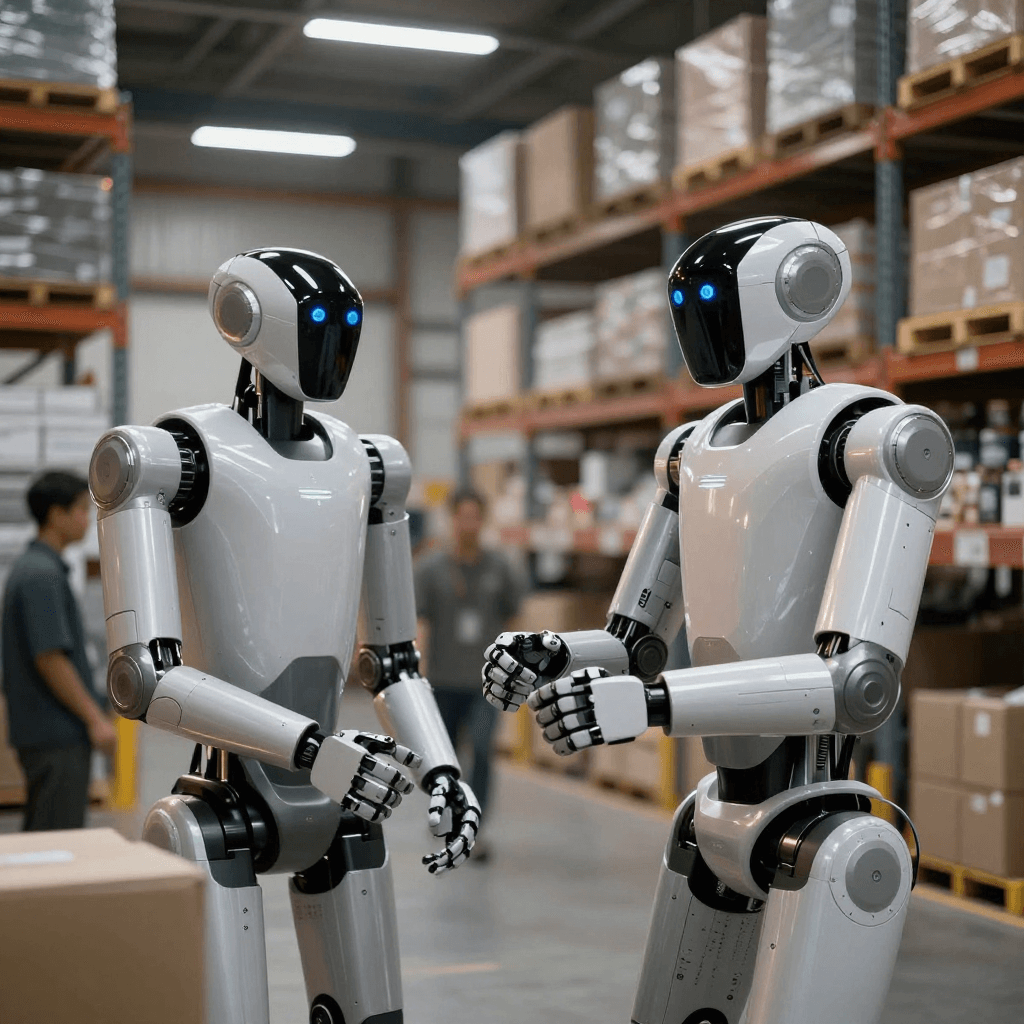
In 2026, humanoid robots are moving beyond factories and logistics warehouses into everyday life. Tesla Optimus Gen 3 is set for a Q1 2026 reveal, Boston Dynamics' Electric Atlas is already running a pilot at Hyundai's Georgia plant, and China's Unitree is targeting 10,000 to 20,000 unit shipments in 2026.
In this post, we compare and analyze the major humanoid robots of 2026 — covering their tech stacks, price ranges, real-world deployment status, and implications from a developer's perspective.
Key Player Comparison
Tesla Optimus (Gen 3)
Tesla's humanoid robot project was first announced at AI Day 2021 and has evolved to Gen 3 as of 2026.
Specs:
- Height: 173cm / Weight: 57kg
- Gen 3 key upgrade: 22-DOF hands (50 actuators) — precision manipulation approaching human hands
- AI: Built on the same neural network architecture as Tesla FSD
- Battery: 2.3kWh, approximately 5-hour runtime
Status (Q1 2026):
- Gen 3 prototype reveal upcoming
- Musk acknowledged: "Still in R&D stage, useful tasks are limited"
- Running for training purposes inside Tesla factories
- Target price: 25,000 (at mass production)
# The core of Tesla Optimus — End-to-End Neural Network
# Same approach as FSD: camera input → action output
class OptimusPolicy:
    def __init__(self):
        self.vision_encoder = ViT(patch_size=16, dim=1024)
        self.action_decoder = TransformerDecoder(
            num_layers=12,
            num_actions=22,  # 22-DOF hands
        )

    def forward(self, camera_inputs):
        features = self.vision_encoder(camera_inputs)
        actions = self.action_decoder(features)
        return actions  # Joint torques for 22 DOF
Boston Dynamics Atlas (Electric)
Completely redesigned from hydraulic to electric, Electric Atlas aims for commercial deployment in 2026.
Specs:
- Fully electric drive (quieter and more efficient than hydraulic)
- 360-degree rotating joints — wider range of motion than humans
- AI: Collaboration with Google DeepMind (reinforcement learning-based control)
Status:
- Pilot operation at Hyundai's Georgia RMAC (Robotic Manufacturing Automation Center)
- Estimated commercial price: 150,000
- Commercial launch planned for 2026–2028
- Recent demo: Human-level balance recovery, backflips
Figure AI (Figure 02/03)
Figure AI is the fastest-growing humanoid startup since its founding in 2022.
Key Features:
- Helix AI: Proprietary Foundation Model for robot control
- BotQ: A factory where their own robots assemble their own robots (self-replication!)
- Partnership with OpenAI (GPT-based natural language command understanding)
Status:
- Figure 02: Pilot operation at BMW factories
- Figure 03: Scheduled for commercial facility pilot deployment in 2026
- Cumulative funding: $7.5B+ (investments from Microsoft, NVIDIA, OpenAI)
Unitree G1 (China)
Unitree, the Chinese robotics company that disrupted the market with aggressive pricing.
Specs:
- Price: 99,000 (depending on configuration)
- China domestic: 85,000–99,000 yuan (approximately 14,000)
- Capable of advanced movements including kung fu and backflips
Status (2026):
- Approximately 5,500 units shipped in 2025
- 2026 target: 10,000–20,000 units shipped
- Went viral with a kung fu performance at the 2026 Spring Festival Gala
- UBTECH Walker S2: Deployed for border patrol operations ($37M contract)
1X NEO (Norway)
1X Technologies, targeting the home robot market.
Key Points:
- Optimized for home environments (dishwashing, cleaning, organizing items)
- Soft exterior design (non-threatening)
- Scheduled for first delivery to U.S. early access customers in 2026
Tech Stack Analysis
1. Control Systems
Modern humanoid robot control is divided into three layers:
High-level (Planning): LLM/VLM-based natural language understanding → task decomposition Mid-level (Skills): Reinforcement learning policies → motion sequence generation Low-level (Execution): PD control / torque control → joint actuation
# Three-layer control architecture example
class HumanoidController:
    def __init__(self):
        # High-level: LLM for task understanding
        self.planner = VisionLanguageModel("gemini-2.5-pro")
        # Mid-level: RL policy for motion
        self.policy = PPOPolicy(obs_dim=128, act_dim=44)
        # Low-level: PD controller for joints
        self.pd = PDController(kp=100, kd=10)

    def execute(self, command: str, observation):
        # "Pick up the cup on the table"
        subtasks = self.planner.decompose(command, observation)
        # ["Locate cup", "Extend arm", "Grip", "Lift"]
        for task in subtasks:
            target_pose = self.policy.predict(task, observation)
            torques = self.pd.compute(target_pose, current_pose)
            self.robot.apply(torques)
2. Hands (Dexterous Manipulation)
The biggest technological advancement in 2026 is hands:
- Tesla Gen 3: 22-DOF, 50 actuators — can pick up an egg without breaking it
- Figure Helix: Vision-tactile integration — adjusts grip force after recognizing object material
- Shadow Robot Dexterous Hand: 24-DOF — most precise but priced at $100K+
3. AI/ML Stack
┌─────────────────────────────────────┐
│        Natural Language (LLM)       │  ← "Fetch part A from the shelf"
├─────────────────────────────────────┤
│     Vision (ViT / DINO v2)          │  ← 6 cameras, depth sensors
├─────────────────────────────────────┤
│  Imitation Learning / RL Policy     │  ← Simulator + real demos
├─────────────────────────────────────┤
│     Sim-to-Real Transfer            │  ← Isaac Sim, MuJoCo
├─────────────────────────────────────┤
│   Motor Control (Torque/Position)   │  ← Real-time 1kHz control
└─────────────────────────────────────┘
Price Comparison
| Robot | Company | Price (Est.) | Deployment Status |
|---|---|---|---|
| Optimus Gen 3 | Tesla | $20K–25K (goal) | R&D stage |
| Electric Atlas | Boston Dynamics | $140K–150K | Pilot |
| Figure 02/03 | Figure AI | Undisclosed | BMW pilot |
| G1 | Unitree | $16K–99K | 10–20K units/2026 |
| NEO | 1X Technologies | Undisclosed | Early access |
| Walker S2 | UBTECH | Undisclosed | Military deployment |
| Apollo | Apptronik | Undisclosed | $935M funding |
Developer Perspective: Why You Should Pay Attention
ROS 2 + Reinforcement Learning Ecosystem
Most humanoid robots are built on ROS 2. If you're a developer interested in robotics:
# Hands-on humanoid control with ROS 2 Humble + MuJoCo simulator
sudo apt install ros-humble-desktop
pip install mujoco gymnasium

# Unitree G1 simulation environment
git clone https://github.com/unitreerobotics/unitree_mujoco
cd unitree_mujoco && python simulate_g1.py
MLOps for Robotics
The training → deployment pipeline for robot AI models is similar to LLM serving:
- Data Collection: Simulator + teleoperation demos
- Training: PPO/SAC reinforcement learning or Behavior Cloning
- Sim-to-Real: Adapting to reality with Domain Randomization
- Deployment: Inference on robot onboard GPU via ONNX/TensorRT
- Monitoring: Collecting failure cases → retraining loop
Kubernetes + Robot Fleet Management
Managing thousands of robots requires cloud-native infrastructure:
- K8s + FogROS 2: Robot-cloud hybrid computing
- Fleet Management: Robot OTA updates, remote monitoring
- Edge AI: On-device inference with NVIDIA Jetson Orin
Outlook Beyond 2026
- 2026: Full-scale factory/logistics pilots (Atlas, Figure, Unitree)
- 2027: First commercial launch of home robots (1X NEO, Unitree home model)
- 2028: Tesla Optimus mass production begins (Musk's target)
- 2030: Robot labor begins replacing humans in specific industries
Key variable: AI control capability (hardware is already sufficient; software is the bottleneck)
Conclusion
2026 is the turning point where humanoid robots transition from "demo videos" to "real factories." Tesla is still in R&D, but Boston Dynamics and Unitree have already begun actual deployments.
What developers should note: The core bottleneck in robotics is no longer hardware — it's AI/software. LLMs, reinforcement learning, Sim-to-Real, and K8s infrastructure for managing robot fleets — these are all natural extensions of the tech stacks we already have.
References:
- Tesla Optimus Complete Analysis 2026
- Boston Dynamics Atlas Production
- Figure AI BotQ Factory
- Unitree G1 2026 Shipment Plans
- Humanoid Robots 2025-2026 Analysis
Quiz — 2026 Humanoid Robots (Click to reveal!)
Q1. What is the key upgrade in Tesla Optimus Gen 3? ||22-DOF hands (50 actuators) — dramatically improved precision manipulation||
Q2. Which company targets the highest shipment volume in 2026, and how many units? ||Unitree — 10,000 to 20,000 units||
Q3. What is the estimated price of Boston Dynamics Electric Atlas? ||150,000||
Q4. What is Figure AI's proprietary AI system called and what are its features? ||Helix — Foundation Model-based robot control, also applied to the BotQ factory where their own robots assemble their own robots||
Q5. Describe the three-layer control architecture of humanoid robots. ||High-level (LLM/VLM, task decomposition) → Mid-level (RL policy, motion sequences) → Low-level (PD/torque control, joint actuation)||
Q6. What is the price range of the Unitree G1? ||99,000 (varies by configuration)||
Q7. What is 1X NEO's target market? ||Home use — household tasks such as dishwashing, cleaning, and organizing items. Scheduled for U.S. early access delivery in 2026||
Q8. What is Domain Randomization in Sim-to-Real Transfer? ||A technique that generalizes the model by randomly varying physics parameters (friction, mass, lighting, etc.) during simulator training, so that it performs well in real-world environments||