- Authors
- Name
- 1. What is Quantization?
- 2. GPTQ (GPU-Optimized Quantization)
- 3. AWQ (Activation-aware Weight Quantization)
- 4. GGUF (llama.cpp Format)
- 5. Using Quantized Models with vLLM
- 6. Benchmark Comparison
- 7. Practical Selection Guide
- 8. Quiz
- Quiz
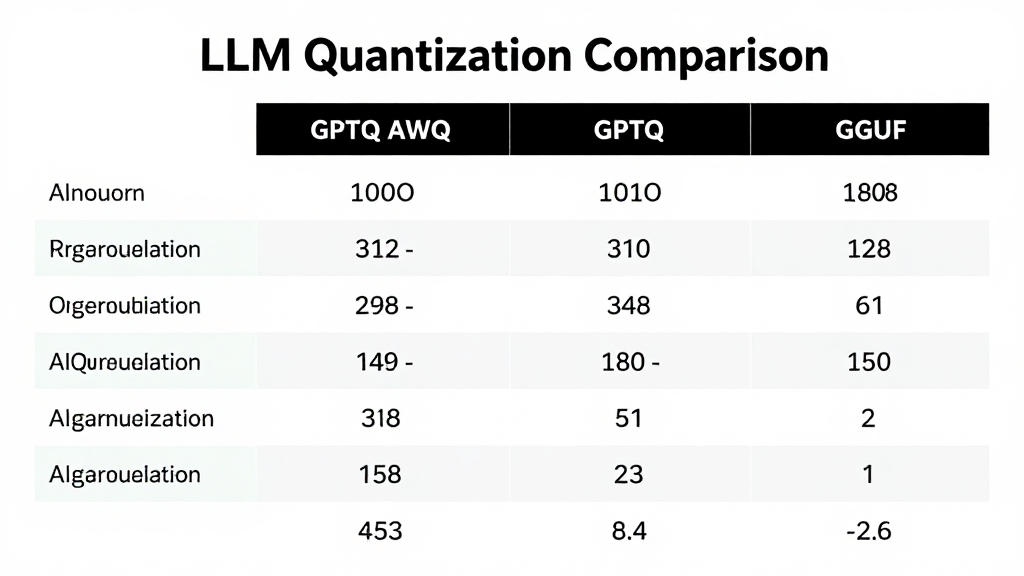
1. What is Quantization?
Quantization is a technique that represents model weights at lower precision to improve memory usage and inference speed. Reducing FP16 (16-bit) weights to INT4 (4-bit) saves approximately 4x memory.
Types of Quantization
- PTQ (Post-Training Quantization): Quantization after training. GPTQ, AWQ, and GGUF all use PTQ
- QAT (Quantization-Aware Training): Simulates quantization during training
Memory by Bit Width
| Precision | 7B Model Memory | 70B Model Memory |
|---|---|---|
| FP32 | 28 GB | 280 GB |
| FP16 | 14 GB | 140 GB |
| INT8 | 7 GB | 70 GB |
| INT4 | 3.5 GB | 35 GB |
2. GPTQ (GPU-Optimized Quantization)
GPTQ performs layer-wise quantization based on Optimal Brain Quantization (OBQ). It uses calibration data to minimize quantization error.
Running GPTQ Quantization
from transformers import AutoModelForCausalLM, AutoTokenizer
from optimum.gptq import GPTQQuantizer

# Load model
model_id = "meta-llama/Llama-3.1-8B-Instruct"
tokenizer = AutoTokenizer.from_pretrained(model_id)
model = AutoModelForCausalLM.from_pretrained(
    model_id, torch_dtype="auto", device_map="auto"
)

# Prepare calibration data
from datasets import load_dataset
dataset = load_dataset("wikitext", "wikitext-2-raw-v1", split="train")
calibration_data = [tokenizer(text["text"]) for text in dataset.select(range(128))]

# GPTQ quantization
quantizer = GPTQQuantizer(
    bits=4,
    group_size=128,
    desc_act=True,       # Quantize in activation order
    damp_percent=0.01,
    dataset=calibration_data,
)
quantized_model = quantizer.quantize_model(model, tokenizer)

# Save
quantized_model.save_pretrained("./llama-3.1-8b-gptq-4bit")
tokenizer.save_pretrained("./llama-3.1-8b-gptq-4bit")
GPTQ Characteristics
- GPU-optimized kernels (ExLlama, Marlin)
- Requires calibration data (typically 128-256 samples)
- Smaller group_size means higher accuracy but slower speed
3. AWQ (Activation-aware Weight Quantization)
AWQ is a method that analyzes activation distributions to protect important weight channels. Instead of quantizing all weights equally, it scales weights of channels with large activation magnitudes to preserve precision.
Running AWQ Quantization
from awq import AutoAWQForCausalLM
from transformers import AutoTokenizer

model_id = "meta-llama/Llama-3.1-8B-Instruct"
quant_path = "./llama-3.1-8b-awq-4bit"

# Load model
model = AutoAWQForCausalLM.from_pretrained(model_id)
tokenizer = AutoTokenizer.from_pretrained(model_id)

# AWQ quantization config
quant_config = {
    "zero_point": True,
    "q_group_size": 128,
    "w_bit": 4,
    "version": "GEMM"    # GEMM or GEMV
}

# Run quantization
model.quantize(tokenizer, quant_config=quant_config)

# Save
model.save_quantized(quant_path)
tokenizer.save_pretrained(quant_path)
Key Differences Between AWQ and GPTQ
| Item | GPTQ | AWQ |
|---|---|---|
| Approach | Layer-wise error minimization | Activation-based channel protection |
| Calibration | 128+ samples required | Possible with fewer samples |
| Quantization Speed | Slow (several hours) | Fast (tens of minutes) |
| Inference Speed | Fast with ExLlama kernel | Fast with GEMM kernel |
| Accuracy | High | Similar or slightly better |
4. GGUF (llama.cpp Format)
GGUF is a quantization format used by llama.cpp that supports hybrid CPU + GPU inference.
GGUF Quantization Method Types
| Method | Bits | Description |
|---|---|---|
| Q2_K | 2.5 | Extreme compression, significant quality loss |
| Q4_K_M | 4.8 | Most popular balance point |
| Q5_K_M | 5.5 | High quality retention |
| Q6_K | 6.6 | Near FP16 quality |
| Q8_0 | 8.0 | Nearly lossless |
| IQ4_XS | 4.3 | Importance matrix based |
Running GGUF Conversion
# Build llama.cpp
git clone https://github.com/ggerganov/llama.cpp
cd llama.cpp && make -j$(nproc)

# Convert HuggingFace model to GGUF
python convert_hf_to_gguf.py \
  ../Llama-3.1-8B-Instruct \
  --outfile llama-3.1-8b-f16.gguf \
  --outtype f16

# Apply quantization
./llama-quantize \
  llama-3.1-8b-f16.gguf \
  llama-3.1-8b-Q4_K_M.gguf \
  Q4_K_M

# More accurate quantization with importance matrix (IQ series)
./llama-imatrix \
  -m llama-3.1-8b-f16.gguf \
  -f calibration.txt \
  -o imatrix.dat

./llama-quantize \
  --imatrix imatrix.dat \
  llama-3.1-8b-f16.gguf \
  llama-3.1-8b-IQ4_XS.gguf \
  IQ4_XS
5. Using Quantized Models with vLLM
# GPTQ model
vllm serve ./llama-3.1-8b-gptq-4bit \
  --quantization gptq \
  --max-model-len 8192

# AWQ model
vllm serve ./llama-3.1-8b-awq-4bit \
  --quantization awq \
  --max-model-len 8192

# GGUF model (vLLM 0.6+)
vllm serve ./llama-3.1-8b-Q4_K_M.gguf \
  --max-model-len 8192
llama.cpp Server
./llama-server \
  -m llama-3.1-8b-Q4_K_M.gguf \
  --host 0.0.0.0 \
  --port 8080 \
  -ngl 99 \          # Number of GPU layers
  -c 8192 \          # Context length
  --n-predict 2048
6. Benchmark Comparison
Benchmark for 7B model (RTX 4090):
| Method | VRAM | tok/s (generation) | Perplexity | Quantization Time |
|---|---|---|---|---|
| FP16 | 14 GB | 95 | 5.12 | - |
| GPTQ-4bit | 4.2 GB | 145 | 5.28 | 2-4 hours |
| AWQ-4bit | 4.0 GB | 150 | 5.25 | 30 min |
| GGUF Q4_K_M | 4.5 GB | 130 | 5.30 | 5 min |
| GGUF Q5_K_M | 5.3 GB | 120 | 5.18 | 5 min |
7. Practical Selection Guide
GPU-only serving (vLLM) → AWQ (fast quantization + good performance)
GPU-only serving (accuracy-focused) → GPTQ (desc_act=True)
CPU + GPU hybrid → GGUF Q4_K_M
MacBook / CPU-only → GGUF Q4_K_M or Q5_K_M
Extreme compression → GGUF IQ4_XS (with imatrix)
8. Quiz
Q1: Why is AWQ faster to quantize than GPTQ?
GPTQ computes the Hessian inverse for each layer and quantizes weights sequentially, which is computationally expensive. AWQ only analyzes activation distributions to identify important channels and applies scaling, enabling fast quantization without complex optimization processes.
Q2: What do the K and M in GGUF Q4_K_M stand for?
K: Refers to the K-quant method. It is a mixed quantization approach that applies different bit widths depending on the importance of each layer. M: Stands for Medium quality. There are S (Small), M (Medium), and L (Large) variants, where L allocates higher bits to more layers.
Q3: Should you choose GPTQ or AWQ for vLLM?
In most cases, AWQ is recommended:
Quantization speed is much faster (30 minutes vs several hours) Inference performance is similar or slightly better The perplexity difference is negligible
However, if maximum accuracy is required, GPTQ (desc_act=True) may have a slight edge.
Quiz
Q1: What is the main topic covered in "Complete LLM Quantization Comparison — GPTQ vs AWQ vs
GGUF"?
A comprehensive guide to LLM Quantization — from quantization fundamentals to comparing GPTQ, AWQ, and GGUF methods, vLLM/llama.cpp integration, and practical benchmarks.
Q2: What is Quantization??
Quantization is a technique that represents model weights at lower precision to improve memory
usage and inference speed. Reducing FP16 (16-bit) weights to INT4 (4-bit) saves approximately 4x
memory.
Q3: Explain the core concept of GPTQ (GPU-Optimized Quantization).
GPTQ performs layer-wise quantization based on Optimal Brain Quantization (OBQ). It uses
calibration data to minimize quantization error.
Q4: What are the key aspects of AWQ (Activation-aware Weight Quantization)?
AWQ is a method that analyzes activation distributions to protect important weight channels.
Instead of quantizing all weights equally, it scales weights of channels with large activation
magnitudes to preserve precision.
Q5: How does GGUF (llama.cpp Format) work?
GGUF is a quantization format used by llama.cpp that supports hybrid CPU + GPU inference. GGUF
Quantization Method Types Running GGUF Conversion